
At the beginning of this month, I had the pleasure of attending once again one of my favorite agile and lean conferences—XP 2024, the 25th International Conference on Agile Software Development in Bolzano, Italy. One thing I appreciate about this conference is the excellent mixture of industry practitioners, university researchers, and a select group of well-known independent agile experts.
Getting to the site from Nuremberg was challenging due to severe flooding in the Munich region, a stark reminder of the climate crisis. Train services were disrupted, forcing me to take a detour through Passau and Linz, with an unexpected overnight stay in Innsbruck due to a missed connection. Consequently, I missed the Wednesday morning keynote by the wonderful Diana Larsen, co-author of the well-known book „Agile Retrospectives,“ recently published in its second, revised edition. Despite this, many great talks were yet to come.
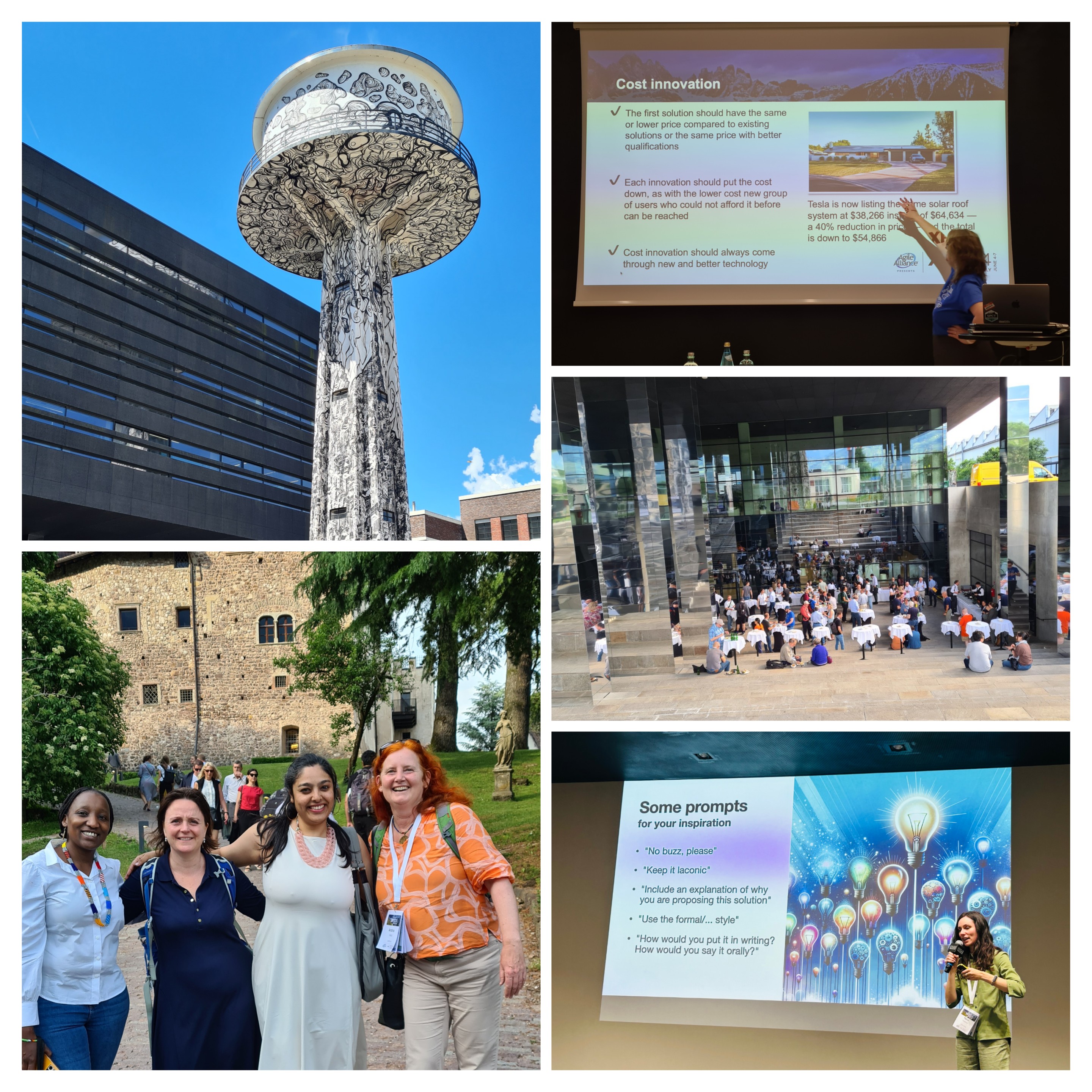
Maarit Laanti delivered two speeches, one based on her extensive experience as an Agile Enterprise Coach and contributor to the SAFe model. In her second talk, „Accelerating the Digital Revolution: Agile Hardware and Sustainability,“ she provided several insightful examples of how companies can benefit from agile methods. She explained how these methods contribute to sustainability goals by enabling development, production, and transportation with less material, less energy, and more cyclic usage of resources.
Semira Allen delved into the heart of Gen Z, convincing us to recognize their potential as torchbearers of agile innovation. While we shared some doubts about how to pave the way for them, she highlighted how crucial it is to harness their potential in our company environments.
Ondrej Dvorak shared his experience of applying Lean Startup methods to a crisis situation, specifically helping people fleeing Ukraine by designing a web portal to connect them with legal support in various countries. His presentation was a valuable reminder of how much can be achieved by a small group of dedicated individuals during a crisis, and how these methods can also be applied to new business ideas in more typical circumstances.
Another fresh voice in agility was Gladys Ng’weno, an Agile Coach from Nairobi, Kenya. She applied her agile coaching skills, honed in her work with software teams, to a cross-functional team in Kenya’s Maasai Mara conservancies. This team, composed of biologists, rangers, and local representatives, aims to balance the needs of wildlife, tourism, and the local population.
Some presentations deserve their own articles:
Yuliia Pieskova, the young CEO and co-founder of AI startup Alpha Affinity, gave an inspiring presentation titled „Agile Coach v.2, Powered by AI.“ We were all excited to apply the strategies and tactics she shared. Additionally, she facilitated a workshop to practice prompts for agile coaches needing technical support. I was impressed by her speaking skills and professionalism.
Hendrik Esser, a well-known expert in agile transformations and scaling at Ericsson, is now the top manager for Ericsson’s Cloud IMS Solution. His new presentation, „Agile and the Management Grind – My Journey to Complexity Leadership,“ emphasized the importance of adapting leadership styles to the complexity of each topic. His lively talk culminated in a table that made the choices easily transparent.

Overall, it was a fantastic experience to be there, reconnecting with great people who have significantly contributed to agility in many companies, including our Datev eG in Germany. Special thanks to Diana Larsen, Maarit Laanti, and Hendrik Esser for their invaluable contributions.
The 25th XP conference was also an opportunity to reflect on past conferences, bringing to my mind especially the teachings of Mary and Tom Poppendieck.
It was wonderful to meet and get to know many new colleagues who are passionate about agile methods and will undoubtedly advance the field even further. Thanks to the organizers and the program team, headed by Xiaofeng Wang—You rocked it!


 Andrea's Agile Reflections